Birding Articles

Wednesday, January 18, 2023

Keeping Bird Feeders Clean and Healthy

With the recent wet weather comes an increased risk for wet bird seed. Routinely cleaning your bird feeder can reduce the risk of disease transmission and keep your birds happy and healthy. 

Keeping your feeders clean and your seed fresh can help stop the transmission of disease and the forming of mold in the seed. Diseases can be passed from bird to bird through their droppings, and when there is a concentration of birds (such as at a bird feeder), it can be easy to spread disease amongst several birds at a time. This can be the most devasting for birds that flock together in colonies, such as Pine Siskins. The siskins do everything together from roosting, to nesting and feeding. Pine Siskins appear to have a weaker immune system than other finches, and diseases spread quickly through the colony once caught. 

Making sure your seed stays fresh and you clean up any old seed from underneath your feeders can help prevent mold growth. Mold can form on old, wet birdseed either on the ground or still in your feeders, and is a health risk for birds. During winter months when food is scarcer, birds will scavenge whatever they can, and that sometimes includes moldy seed. Ingesting moldy seed or simply inhaling the mold spores can lead to birds becoming ill. 

The easiest way to combat disease at your feeders is by cleaning them at regular intervals. Cleaning feeders once a week, especially during wet weather, is ideal and can help keep them free of problems. When cleaning bird feeders, we recommend using either a bleach-water mixture (1 part bleach to 9 parts water) or cleaning vinegar (industrial white vinegar, not to be confused with cooking vinegar) and water (from 25% vinegar and 75% water to 50-50). This helps disinfect feeders as well as keep them clean for your birds. 

Your preferred cleaning solution can be kept in a spray bottle for ease of use. When cleaning out feeders make sure to remove any old seed and throw it out. Use a small brush or whiskbroom to get any stuck seeds out. Give your feeder a good spray with your cleaner, and scrub with your brush. Rinse out with fresh water and let it dry. Both wood and plastic feeders should be cleaned regularly, and our recommended cleaning solutions are safe for both. Also make sure to clean up underneath feeders, and in any area you may have put out seeds a couple times a week if possible. You can also use the bleach-water or vinegar-water mixtures to clean your bird bath.

Hummingbird feeders also need to be cleaned regularly. Nectar can be premixed and kept in your fridge for up to two weeks, but nectar in your feeder should be replaced at least once a week during the winter, and 2-3 times a week during warm summers. When cleaning your hummingbird feeder, avoid soaps that can leave a residue. Using the bleach-water mixture we recommended is ideal as the bleach evaporates off as it dries and leaves no residue behind that can harm your birds. Cleaning hummingbird feeders regularly and wiping any nectar drippings off can also help with keeping insects from finding your feeder.

Tip: Cleaning feeders in the evening allows them to dry overnight and be put back out in the morning with fresh seed.

Cleaning your feeder and keeping your birds healthy can be made easier by choosing the right bird feeder. Look for feeders that can be completely disassembled. The cracks and corners of your feeder is where the mold is likely to grow. The more you can take apart, the better you can clean. 

Fresh bird seed can soak up moisture, especially on feeders with a wooden base. Wood feeders should have a screen base to allow water to run out and air to circulate through. Feeders with a large roof to help keep the rain out are ideal in our Vancouver Island weather. Add a roof shingle, piece of plastic or wood, or cedar shingle to the edge of your wooden feeder's roof to extend the overhang and keep your seed dryer. 

Remember, extending the overhang can help protect seed but it can also make it more difficult or impossible for larger birds to get into your feeders at all.

If you notice that your bird seed is always clumping together, or looks wet, an easy solution can be changing the type of seed you are using. Wild bird mixes with lots of white millet can clump more easily in wet weather, and any raw seed is more susceptible to moisture. Switching to straight black oil sunflower, or a mix that is primarily black oil sunflower, can be a good option.

We feed birds for two main reasons; to enjoy watching them, and to help them get through rough times. The last thing any of us want is to harm our backyard visitors. Cleaning your bird feeders is as important to bird feeding as filling the feeders with seed. Keeping feeders clean will make watching the birds more enjoyable and be healthier for your feathered friends.

Happy birding!!

Monday, January 9, 2023

Surviving The Cold

How do birds, especially the tiny hummingbirds, survive the cold weather? 

For all birds, survival means finding enough food to make it through the day. Birds live one day at a time and don't really stock up on energy. They start searching for food with the sunrise, and stop when the sun sets again. This doesn't leave them much leeway if the weather takes a turn, or their natural food sources are scarce. 

Varied Thrush

During snowfall, some bird species become more reliant on the supplementary food sources in backyard feeders. With snow hiding seeds and berries, and the cold chasing insects away from the surface, it can be difficult for birds to find enough food to make it through the day. This is the time when backyard feeders, including suet feeders, can get very busy. We saw this in December when the snow hit. 

The importance of food is obvious, but water is also critical during winter since most of it ends up frozen. Providing a dish of water for the birds is useful and can help attract different birds that may not eat at your feeders. Make sure if you're putting out water you use a shallow dish (2" at the deepest) and keep it from freezing. Changing the water if it starts to frost over or adding a bird bath heater are some options to keep the water flowing.


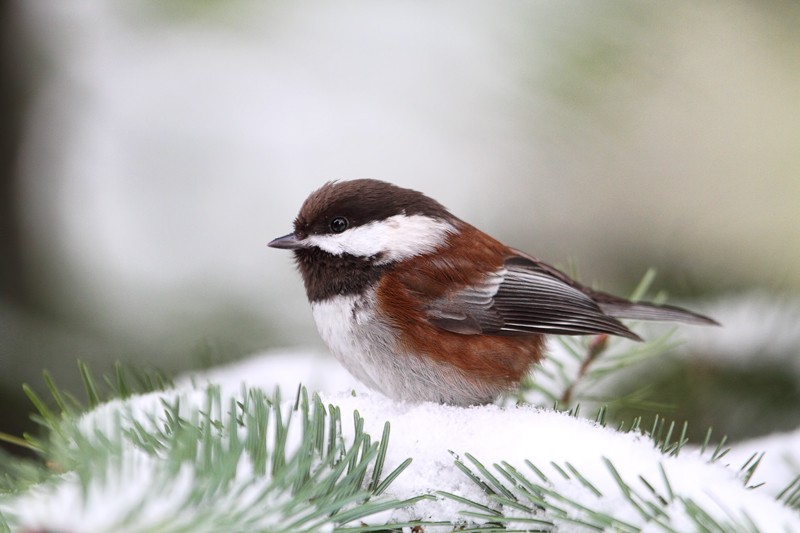
Chestnut-backed Chickadee

As the sun sets, it's time for the birds to settle in and roost for the night. Many species have gathered into flocks for the winter, and these flocks will find a spot together to roost. Roosting spots can be a tree or shrub, an empty nest box, or a tree cavity. These roosting spots help shelter the birds from the weather. Roosting in a flock can also help the birds conserve a bit of energy through the night. 

The Anna's hummingbird lives on Vancouver Island year round and does not migrate over winter. This is not, as some believe, due to the presence of hummingbird feeders but simply because the Anna's are a non-migratory species to begin with. Having a hummingbird feeder up during winter can help provide these little birds with the energy they need to find food. Hummingbird sugar-water gives them the energy to keep going but it doesn't provide them with any nutrition. The Anna's look for small insects and tree sap as a source of nutrients. During winter, there have even been a few reports of hummingbirds following Red-breasted Sapsuckers to feed at the sap wells that the sapsuckers make in trees. 


Anna's Hummingbird

Hummingbirds can find it difficult to keep warm at night due to their lack of down feathers. In order to conserve enough energy to survive until morning, hummingbirds enter a hypothermic state known as torpor. This torpor state allows hummingbirds to slow their metabolic rate and lower their body temperature. While in torpor, the hummingbird's heart rate drops from approximately 1200 beats a minute down to 50. Without this torpor state, the hummingbird's metabolism is so fast they could starve overnight.

Have you ever spotted a hummingbird hanging upside down from your bird feeders? They are in the torpor state! To avoid falling off their chosen perch, hummingbirds 'lock' their feet into position.

If you do find a hummingbird in a suspected torpor state, the best thing to do is leave them alone and make sure that (if you have a hummingbird feeder) your nectar is out and unfrozen. It's very difficult to determine if the hummingbird is in a torpor, as they will be completely unresponsive until they've woken. 

Good birding!

Saturday, December 31, 2022

The Upside Down Bird

What's blueish-gray in colour, the size of a Pine Siskin, and enjoys spending lots of time upside down? These unique little birds are a frequent visitor to most backyards, often following chickadees to feed from feeders. 


The Red-breasted Nuthatch!

There are three species of nuthatches in British Columbia. The Red-breasted is the most common, and the White-breasted frequents the Okanagan along with the smallest nuthatch; the Pygmy. In Nanaimo, we've had the odd White-breasted sighting. Once near Bowen Park, and another time in the Stephenson Point area. 

In comparison to woodpeckers, who travel up tree trunks looking for insect larvae and eggs, nuthatches start at the top and work their way down. Their upside down habit persists even at backyard feeders. Nuthatches feed sideways or upside down on suet cages, and will take seeds from seed feeders to wedge into a tree trunk so they can turn upside down and crack the shell open for the seed. 

When it comes to identifying the nuthatch, they have many unique features that can be used to describe them. They are sometimes described as the "bird with no tail" as they have very short tails, or as a "little bird with no neck" due to their compact shape. The Red-breasted Nuthatch can be easily identified from it's call, a nasal yak yak yak sound that can be heard as they move through the trees. This bird is about 4 1/2" in size, with an 8" wingspan. They have a blueish-gray back and wings with a rufous (rusty) coloured underside and chest. The head has been described as both black with a white cheek stripe and white eyebrow, and white with a black cap and black eye stripe. Their slender, pointed bill is similar to that of a chickadee, and is designed to dig for insect eggs and larvae as well as get seeds out of cones. Their bill is not made to crush seeds like finches do, so when they feed on sunflower seeds they take one at a time to wedge into tree bark, and peck it open for their reward before returning for another seed. 

Like chickadees and Steller's Jays (and squirrels), nuthatches cache seeds, hiding them around as an emergency food source. Ideally, they would never need to touch these stores of seeds. If you ever have sunflowers growing out of a crack or other strange places, you may have had a bird caching seed there over winter.

To attract Red-breasted Nuthatches to your yard you can provide them with their preferred food sources such as sunflower seeds, peanut halves or other nuts, and suet. Nuthatches will use open tray feeders, tube style feeders, and hopper feeders. They are also able to access suet in anything from an onion sack to an upside down suet feeder. 

When nesting, nuthatches use cavities and build their nests inside. Like chickadees, wrens, swallows, and house sparrows, nuthatches will use nest boxes. The nest box should have a hole size of 1 1/8", just big enough for them but too small for House Sparrows to reduce the risk of the nuthatches being forced out. The nest box is ideally placed near Fir and Cedar trees as these trees are their usual habitat, and the entrance hole should face away from weather as much as possible. Make sure when placing the box not to bury it deep in branches. When looking for cavities to nest in, these little birds are searching for that dark hole, which can be difficult to find when the box is too deep in cover.

The Red-breasted Nuthatch is a bold little bird with unique habits that make it easily identifiable. They are brave enough to sometimes take seeds right from your hand, and are a joy to watch flit about with the chickadees. 

Happy Birding!


Tuesday, December 27, 2022

Bushtits

Have you ever looked out at your suet feeder only to see it covered in small greyish birds? Those are Bushtits, and they are a very social group during the winter months. Bushtits travel around in flocks of 40+ birds and only have one goal: food. Typically, bushtits feed on insects and can be spotted bouncing around in shrubs and trees looking for their next meal. While they primarily go for insects, you can find the bushtits at your suet feeder and even sometimes going for the hulled sunflower and peanuts as a supplementary food supply. As they are very social birds, you are likely to see ten or twelve of them on your suet feeder at once, before they fly off for the next group of twelve. Once the flock has fed, they are off as quickly as they came. 

Bushtits are commonly—and accurately—described as small grey birds without any field markings that are always on the move. They are about 4 inches in size, slightly smaller than a chickadee, with a tail that looks long compared to their body. The bushtits are grey with a bit of a brownish colour on their head, and no other field markings. They have tiny bills, smaller than those of a chickadee. Bushtits are always moving, and they are also chattering to each other constantly with short tseep and tsip calls. Often you can hear them high in the treetops long before you see them.


When spring arrives, Bushtits pair up for nesting and become more territorial. Bushtit nests are a unique 'sack' shape that hangs below a branch. They weave their nests together from the top down. with the entrance hole at the top. Bushtits nests are between seven and ten inches long, and take roughly thirty days to construct. They build their nests with fine fibers, leaves, grass, and spider webs, and cover it with moss for camouflage. The inside of the nest is lined with feathers, plant down, and hair. Bushtits nests are often not well hidden and can be spotted alongside trails and paths if you look closely. Do be cautious, as bushtits get nervous during nesting season and if they are disturbed while they build their nests or incubate their eggs, they will often abandon the nest and separate from their chosen partner to start over somewhere else. 

Keep an eye out for these energetic birds at your backyard suet feeder or in trees and shrubs, as they are a great joy to watch flit about. 

Good birding!


Wednesday, December 7, 2022

Winter Help for the Birds


WINTER HELP FOR THE BIRDS

Written by Colin Bartlett

Now that the winter weather has arrived it is important for the birds that the bird feeders and baths are available. Although birds do not put on fat to help keep them warm they do need to feed frequently to keep their energy levels full, as this is what will keep them warm during the night.

Keeping the feeder topped up with dry seed is a great help to many of the birds seen in the backyard but what about those that winter here and feed on berries and ground insects like the American Robins. One way is to place a piece of plywood, tarp, or some object on the garden or lawn. This cover will create a warm spot and keep the soil from freezing so when the snow flies simply move the cover which will allow access to the bugs in the garden. Another option is to turn the garden soil, about 12 inches deep, which will give access for the birds to find insects.


Other food that can be placed out for the robins and thrush are apples, blueberries, and even cranberries. Cut the apples into quarters or halves and place them along with the berries on a tray in a tree or area that you see the robins frequenting. You may also see the juncos and towhees enjoying them.

Water is another important part of bird daily living, especially in freezing temperatures. Birds use the water for drinking as well as bathing, even in the cold temperatures. They need to keep their feathers clean and organized to keep them warm. If there is any dirt in their feathers it allows cold to get in, similar if your winter coat had a hole in it. A bird bath heater can be used to keep a bird bath from freezing and attract the birds to your backyard as it will probably be the only water source available. The convenience is not going out every morning in the cold to deice the bird bath. If the bird bath is put away for the winter use a shallow dish, about one inch deep, as a temporary bird bath or with a deeper dish place some rocks in the dish to create a shallow pool for the birds.

Winter months are a hard time for the birds especially when covered in snow and ice. Each day the birds need to intake enough energy to survive the day and night and then do it all over again the next day. For most of our other backyard visitors keeping the bird feeders filled with good seed so that it is available first thing in the morning for them to top up their energy used over night is a great help.

Good Birding!

Colin Bartlett

Wednesday, November 23, 2022

Leucism in Wild Birds

Have you ever seen a bird that looks like a certain species, but the colours are too pale or white, either in patches or all over? Found a bird who looks like an albino, but the eyes are dark?

Leucism is when a bird has reduced pigmentation, preventing melanin from being properly deposited in their feathers. Birds with leucism can appear to be paler or white in colour, either in patches or entirely. Affected feathers tend to be weaker and less robust, wearing out faster than feathers with the proper amount of melanin. This can hinder their flight ability and make them more susceptible to predators. The white or pale patches can also impact their ability to camouflage in the environment, which also makes them more vulnerable.

Leucistic birds can be more difficult to identify, as they may be lacking a distinctive marking or colour pattern. They are still identifiable if you remember to look at the size, shape, and behavior of the bird as well as what birds are nearby as leucistic birds often flock with others of the same species. Birds that are leucistic can also lose the white when they molt, though this is not guaranteed.

While leucism is often confused for albinism, they are not the same thing. Leucism may sometimes be referred to as ‘partial albinism’, but it is not. Albinism is when the affected animal has reduced or no melanin in their entire body, including the skin and eyes. While both albino and leucistic birds can have all white feathers, birds with albinism will always have a pink or red beak, feet, and eyes while leucistic birds have the same colour eyes, feet, and beak as non-leucistic birds of the same species.

Monday, November 21, 2022

Birds and Fall


With fall now well upon us, it's the perfect time to look at your seed and backyard feeders to make sure you are prepared for winter. While there are a lot of bird seeds available on the market, there is a far more limited variety that the birds will actually feed on. Seed-eating birds prefer black oil sunflower, white millet, hulled sunflower, peanut halves, nyjer, and cracked corn, though not all birds like them all equally. By using the bird seeds that our local birds prefer, it is easier to keep your feeding area cleaner and attract a variety of species to your backyard.


Many wild bird mixes contain filler seeds such as wheat, oats, milo, and red millet, that our local birds do not eat. These fillers are what the birds are tossing out as they search for the seeds that have the greatest nutritional value they prefer. These discarded seeds create extra work for cleaning up around your feeders and may attract unwanted guests.

For keeping your feeder area as clean as possible, we recommend providing individual seeds in separate feeders, and avoiding the use of mixes. Having only one seed type per feeder helps limit the sorting of your seeds and results in far less waste tossed onto the ground.

The most common seed for backyard feeders is black oil sunflower seed. Black oil sunflower is a high protein, high energy seed that is enjoyed by 70% of backyard birds. Even the little chickadees prefer the black oil sunflower, though it can still make a bit of a mess. When birds are choosing their seeds, they are looking for the most reward for the least amount of effort, so they weigh anything in a shell. If the seed is too light and won't give them a high enough energy return for the amount of work to break into the shell, they toss them. Birds eating anything in a shell will go for the heavier seeds first.

To provide sunflower seed without the mess, and while still attracting the widest variety of birds, chipped sunflower seed is the best choice. This seed has no shell and makes very little mess. All birds eat hulled sunflower seed, but as it is a raw seed without a shell, it absorbs moisture more readily than seeds in the shell. When putting hulled sunflower out, be aware that it can get wet very easily and make sure your bird feeder is well protected from the weather. 

Fall and winter is also when many of the sparrow species start visiting feeders, making it a good time to add white millet to the feeding station. White millet works best in a hopper or tray style bird feeder and not in a tube feeder, as the birds that enjoy it are largely ground feeders and are less likely to use the perches on the tubes. The feeder should also have good coverage to protect against wet weather, as white millet can clump up easily when wet.

If you are using peanut halves, blanched skinless is the way to go to ensure high protein. Roasting peanuts reduces the nutritional value and is less enticing to wild birds. Many backyard bird species feed on peanuts, including chickadees and nuthatches as well as woodpeckers, who will all take the full peanut halves. You can also break the halves into smaller pieces for the towhees and juncos to enjoy. Peanuts in the shell are a common choice for feeding Steller's Jays and squirrels, as they cache them away for winter.


Cracked corn is a less commonly eaten seed, but is preferred by California Quail and popular for feeding ducks. It is best to use a ground feeder, as they are easy for the ground birds to feed on and helps keep the area cleaner than if you placed the corn directly on the ground. Sparrows can also feed on cracked corn but only after it has absorbed a bit of moisture to soften it for easy digestion.

Making sure to put out the type of bird seed that your backyard birds prefer will provide you with a wide variety of birds and plenty of activity to enjoy throughout the winter.

Good Birding!